Stringers in Airplane Design
What are Stringers in Aircraft?
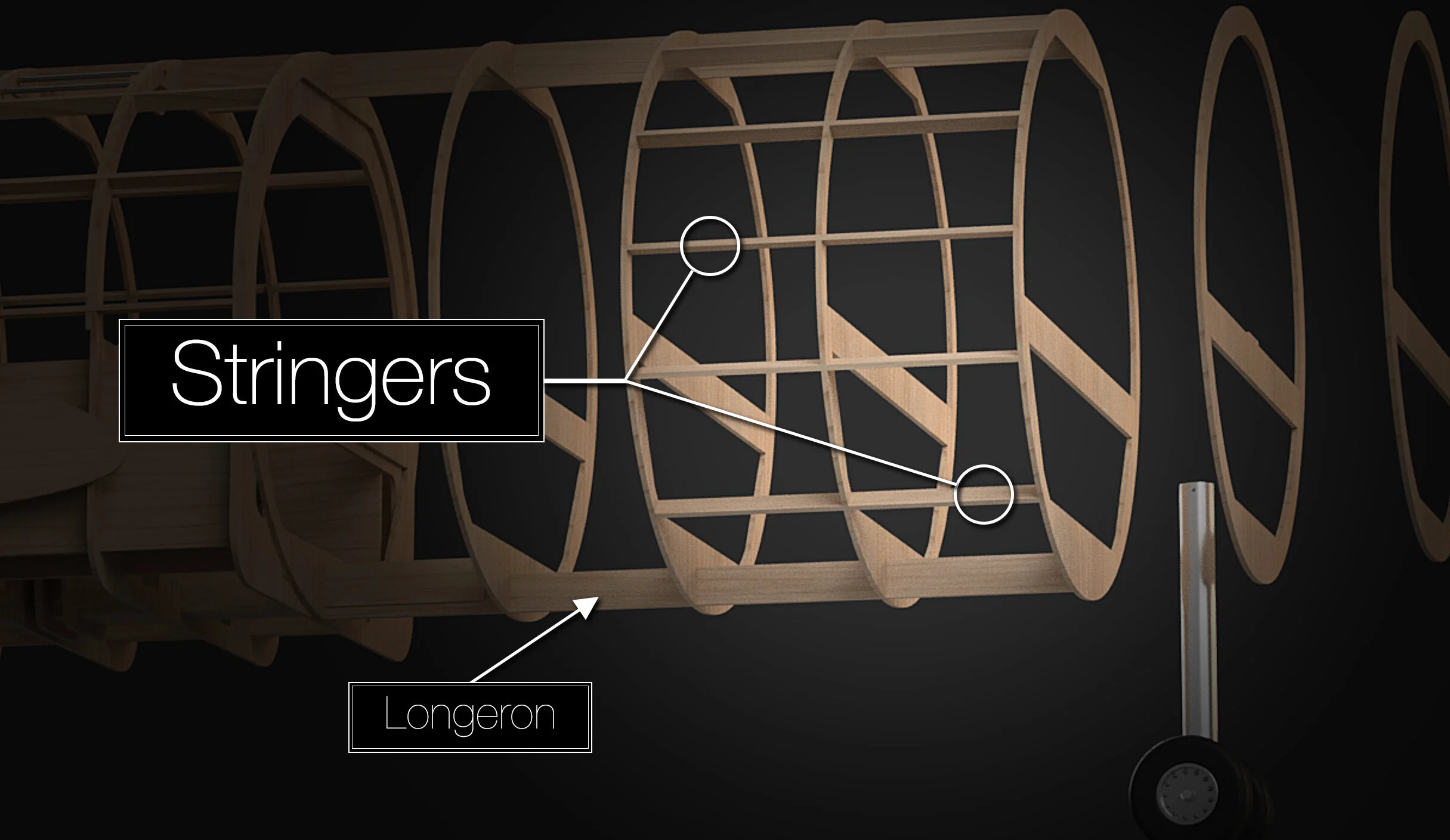
Stringers, sometimes confused with, or referred to interchangeably as longerons, run lengthwise (longitudinally) along an airplane’s fuselage or span wise of a wing. Their purpose is to serve as structural components that transfer loads and stresses from the aircraft’s skin to the formers. Generally, they are attached between formers and bulkheads and are more numerous than longerons and space more closely together.
Individual strings are not strong enough to handle large stresses and forces encountered by an airframe. For this reason, they are directly attached to formers and bulkheads and spaced much more closely than their counterpart, the longeron.
The reason stringers are often confused with longerons is because their purpose is generally the same. Both attach to a fuselage’s formers (also called frames) and transfer the aircraft’s skin stresses into the overall airframe. Stringers in commercial aircraft are used more commonly even though they are more time consuming to install during the manufacturing stage.
Stringers in RC Airplanes
When it comes to building radio controlled model airplanes, it is not uncommon to see the word stringer used for what is technically a longeron. It is often assumed that thin balsa wood or ply wood strips glued to multiple formers or wing ribs are automatically stringers because they are thin. Structurally speaking, these strips are behaving more like a longeron than stringers, especially if they are spaced further apart.
Why the reason for this distinction?
The airframe or wing stresses are being transferred uninterrupted across multiple formers and bulkheads by the strip of wood. Which means the strip of wood needs to be capable of handling greater stresses than a traditional stringer as it is bearing more of the load than the formers and bulkheads.
Let’s examine this a little further
If a fuselage has lengthy strips of wood running lengthwise separated every 60°. Their would be a total of 6 longerons, not stringers since they are behaving more like spars. The overall loading they have to bear is far greater than a stringer design would need to.
On the other hand, if you have short thin strips running lengthwise separated every 30°, their would be a total of 12 stringers. The stresses are transferred and absorbed to a much larger degree by the formers and bulkheads rather than the individual stringer.
True stringers in RC Airplanes are fairly uncommon. Especially in small scale flyers. They are more likely to be incorporated in large or giant scale airplanes. Stringers can add unnecessary weight and complexity to a model, for this reason longerons are a better design structure in RC airplane design.